

LThe Canary Islands are found in the named Macaronesia , a geographical placement that covers three archipelagos: Azores, Canary and Green Cape. Given the location, the Canary Islands, Las Afortunadas or “Jardin de las Hespérides”, as called by Platón, form the link between America and Europe, highlighting, due to the intensive and rich influence of cultures, their cosmopolitan character.
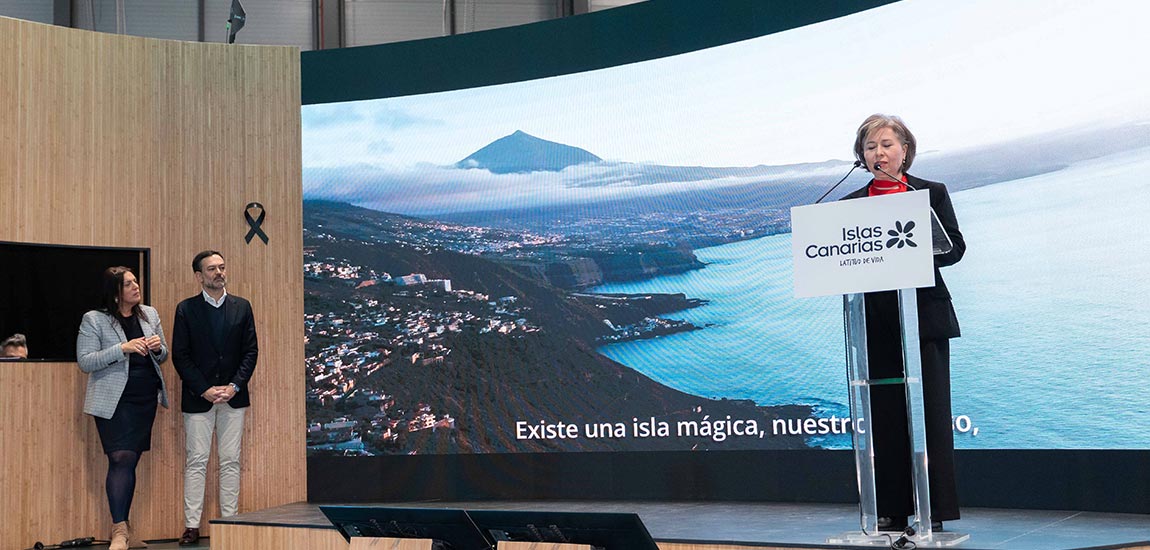
Tenerife is the largest of the seven Canary Islands with a total surface area of approximately 2036 Km2 and is crowned by the spectacular volcano Teide situated in the centre of the island with a height of 3718 metres, the highest peak in Spain.
In proportion Km2 – height above sea level, Tenerife is the highest island in the world. The anti-cyclone of the Azores and the elision winds provoke a meteorological phenomenon which equilibrates the temperatures. The experts claim that the Canary Islands have one of the most balanced climates on the planet . The annual average temperature is of 23ºand differences between the seasons are hardly noticeable which allows us to live in an eternal springtime.
The Island presents a large number of micro climates (up to 54 have been counted) which together with a great variety of ecosystems, endemic animals, vegetation, diverse landscapes and contrasting nature consolidates it as a miniature continent , a micro universe within which the visitor will always be pleasantly surprised and fascinated. In Tenerife one finds beautiful beaches, striking mountain ranges, unthinkable magic forests full of “Laurisilva” fossil vegetation from the tertiary Europe which worldwide can no longer be found. Also one can discover spectacular volcanoes and cliffs, gorgeous green areas of countryside equal to any part of the rest of Europe. All this mixed with desserts, large areas of fruit cultivation, charming villages and a modern capital city: Santa Cruz , which never ceases to amaze.

Lastly, the city of La Laguna , second most important town on the island and the only place in the Canaries that has the title of Heritage of Mankind given by UNESCO.This statement was largely due to its constitution as the first city of peace (no walls) and which retains almost intact its original layout of the fifteenth century .
Highlight the hull of the city's Cathedral of Our Lady of Los Remedios, which is also known as Holy Church Cathedral (neoclassical) with concrete vaults, the Church of the Conception parish on the island whose parent Renaissance Tower stone is the symbol of the city.
{multibox} +PHOTOS
SANTA CRUZ DE TENERIFE
Santa Cruz de Tenerife , with a population of approximately 300.000, is the capital of the Island and of the Province. The city, open to the sea, has always shown a marked cosmopolitan character. This is due mainly to the sea port where millions of visitors and tourists have come and gone favouring the cultural enrichment of the region.

Santa Cruz , today, is an attractive, modern and dynamic European city which offers all types of services. Firstly it is surprising how agreeable it is to go for a walk through its streets. In the city one breathes a quality of life very difficult to find anywhere else.
One can discover a large variety of things to do, but in the cultural area one can find a variety of museums and exhibition halls, the famous Güimera Theatre , of which we will talk about in the web with detail, the Auditorium , the famousTenerife´s Carnival, etc.

The City has a large number of green areas crossed by a beautiful avenue “ Rambla” , an enormous line of Indian Laurels which is considered to be the dorsal spine of the capital. In proportion Green areas – space, it is said that Santa Cruz is the greenest city in Spain. There are also a great number of parks of which the oldest and most famous is called “Garcia Sanabria”.
+PHOTOS{multibox}